Artificial intelligence is changing how teams build software.
For years, GeneXus made it possible to build enterprise applications with high productivity, abstracting technological complexity and accelerating the creation of critical systems. Today that productivity is entering a new stage: AI agents, code assistants and modern tools can help generate, modify, explain and document code at ever-increasing speed.
This opens a huge opportunity for GeneXus teams.
But it also raises a new question:
If we can now generate and modify code faster, how do we ensure each change preserves the quality, security and technical coherence of the Knowledge Base?
That’s where KBDeepdive.AI comes in.
The new challenge: it’s not just about generating more code
The conversation around AI in development tends to revolve around one idea: produce faster.
And it makes sense. AI agents can help with tasks that used to take a lot of time:
- Creating new objects.
- Explaining existing code.
- Proposing changes.
- Documenting logic.
- Helping with refactors.
- Generating tests or validations.
- Speeding up repetitive tasks.
However, in enterprise systems, generating code is only part of the problem.
The real challenge appears afterwards:
- What actually changed?
- Where does that change have impact?
- Did complexity go up?
- Was existing logic duplicated?
- Was a vulnerability introduced?
- Did hardcoded credentials appear?
- Does the change respect the team’s internal rules?
- Is the KB improving or accumulating tech debt?
- How can the tech lead review what matters without losing hours navigating the KB?
When the volume of changes grows, these questions stop being optional.
They become part of the organization’s technical governance.
More speed also means more risk
AI can be a great ally for development teams, but it doesn’t remove the need for technical review.
In fact, when the cost of generating changes drops, the number of changes that may land in the Knowledge Base goes up.
That means teams need more visibility, not less.
A GeneXus KB can contain years of business logic, critical rules, integrations, processes, reused objects, historical dependencies and technical decisions that aren’t always documented.
In that context, an apparently small change can have important consequences.
It can increase the complexity of a procedure.
It can duplicate logic that already existed.
It can modify sensitive attributes.
It can introduce an incomplete validation.
It can leave a key or token in the code.
It can affect objects that other teams don’t know about.
The problem isn’t using AI.
The problem is using AI without a layer of monitoring and control over the KB.
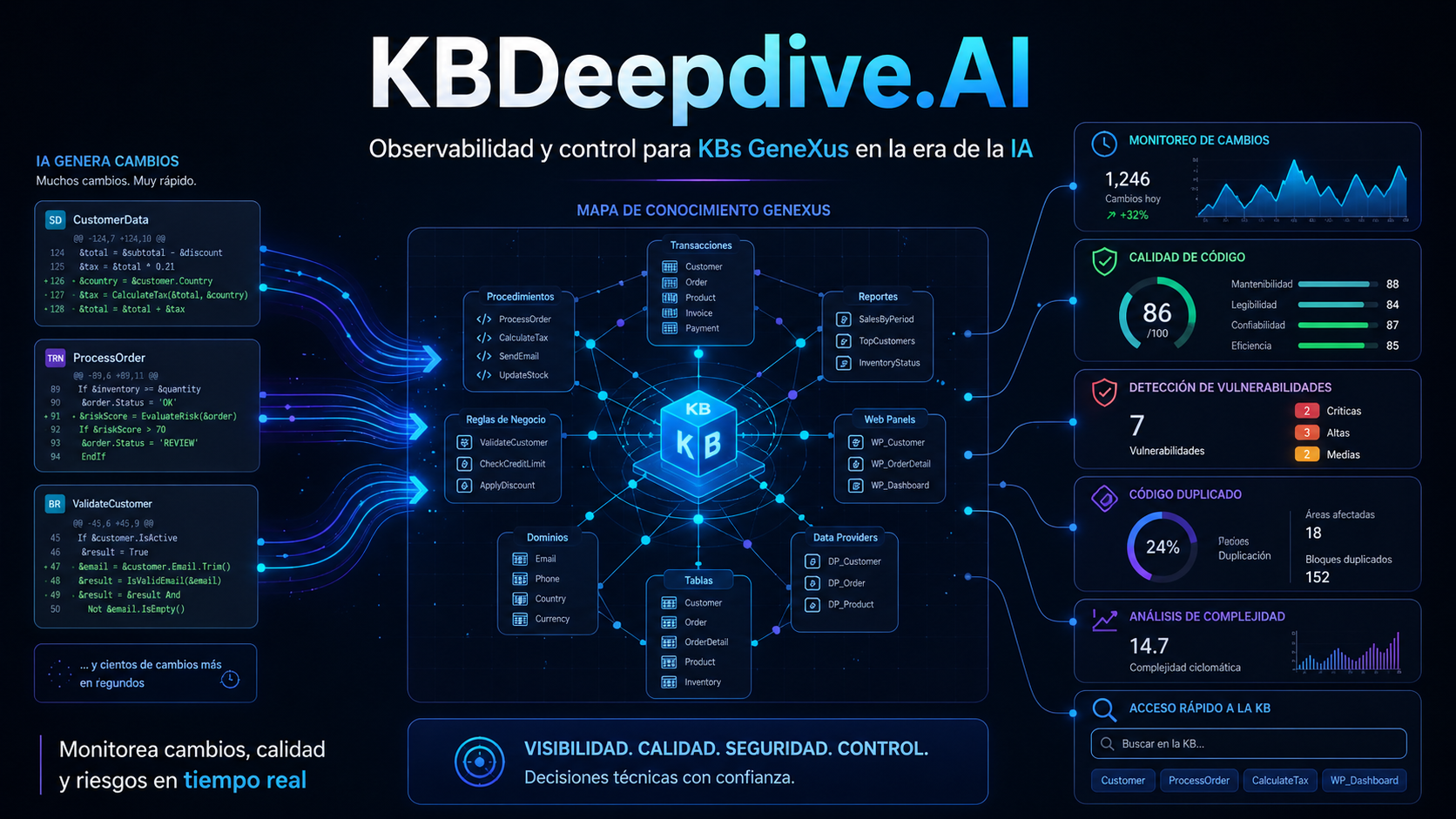
KBDeepdive.AI: an observability layer for GeneXus
KBDeepdive.AI was born to fill that gap.
It’s not just a tool for searching objects.
It also doesn’t aim to replace the IDE or compete with code-generation agents.
Its proposition is different:
KBDeepdive.AI lets you observe, analyze and control the evolution of your GeneXus KBs.
It’s a platform for observability over GeneXus Knowledge Bases, aimed at giving technical visibility over the KB so leads, architects and development teams can quickly understand what’s happening inside their systems.
Instead of relying on manual searches, informal knowledge or isolated reviews, KBDeepdive.AI lets you analyze the KB from a broader perspective:
- Changes.
- Objects.
- Code.
- References.
- Attributes.
- Metrics.
- Duplication.
- Security.
- Complexity.
- AI-powered recommendations.
Fast access to KB information
One of the major problems in enterprise KBs is finding information quickly.
Often, answering a technical question means opening the IDE, navigating objects, looking up references, reviewing code, comparing versions or relying on someone who knows the system’s history.
KBDeepdive.AI gives you fast, direct access to KB information.
Searches include:
- Object name.
- Variables.
- Attributes.
- Code fragments.
- Domains.
- Text within code.
- References.
- Documentation.
- Events.
- Relevant properties.
This speed is key for maintenance, technical analysis, support, onboarding new developers and reviewing changes.
In a large KB, finding fast can be as important as developing fast.
Monitoring changes in the Knowledge Base
KBDeepdive.AI’s value grows particularly when seen as a monitoring tool.
Every change in the KB can be a signal.
A signal of improvement.
A signal of risk.
A signal of tech debt.
A signal of a potential vulnerability.
A signal of impact on other objects.
KBDeepdive.AI lets you turn those changes into actionable information.
This is especially relevant in the new context of AI-assisted development.
If an agent, a developer or an external team modifies objects in the KB, the technical team needs to be able to answer quickly:
- Which objects changed.
- Who made the changes.
- When they happened.
- What logic was modified.
- Which metrics changed.
- Which objects deserve review.
- Which risks were detected.
The idea isn’t to slow down productivity.
The idea is to prevent speed from causing loss of control.
Code quality: complexity, duplication and maintainability
A KB can work correctly while at the same time accumulating technical issues.
That’s why KBDeepdive.AI includes code-quality analysis.
Among other indicators, it can help observe:
- Cyclomatic complexity.
- Cognitive complexity.
- Lines of code.
- Lines of comments.
- Object size.
- Number of parameters.
- Duplicated code.
- Variables or patterns that need review.
These indicators matter because they help detect objects that may become hard to maintain.
An overly complex object can be more error-prone.
A duplicated fragment can create future inconsistencies.
A procedure that’s too large can hinder testing and evolution.
Unclear logic can depend excessively on a specific person.
Measuring doesn’t solve all problems, but it makes visible what is normally hidden.
And what’s visible can be managed.
Security: detect risks before they escalate
In enterprise systems, security can’t be a last-minute add-on.
It has to be part of development and maintenance.
KBDeepdive.AI introduces a security lens over KB objects, helping identify potential vulnerabilities or signals that need review.
For example:
- Hardcoded credentials.
- Sensitive keywords.
- Tokens or keys exposed.
- Risky code patterns.
- Objects flagged as high-risk by AI.
- Improvement recommendations tied to security.
This lets the team avoid relying solely on manual reviews or late audits.
Security becomes part of continuous monitoring of the KB.
AI-powered analysis
KBDeepdive.AI also incorporates AI to enrich object analysis.
From source code and KB information, it can produce:
- A summary of the object’s purpose.
- Possible vulnerabilities.
- Improvement recommendations.
- Risk level.
- Impact level.
- Useful explanations for technical review.
This adds value in several scenarios.
For a tech lead, it helps prioritize reviews.
For a new developer, it helps understand existing objects.
For maintenance, it reduces the time needed to grasp inherited logic.
For audit, it helps detect objects that deserve attention.
For evolution, it helps identify improvement opportunities.
AI doesn’t replace the team’s technical judgment.
It amplifies it.
IDE-independent and compatible with multiple contexts
Many companies have critical GeneXus KBs across different versions.
Some are on recent versions.
Others remain on older versions for operational, commercial or risk reasons.
Many contain systems that are still central to the business.
That’s why having an analysis layer that doesn’t rely exclusively on the traditional IDE flow matters.
KBDeepdive.AI positions itself as a query, analysis and monitoring tool that gives you fast access to KB information and value without forcing the team to fully change how it works.
This is especially useful for:
- Companies with multiple KBs.
- Teams with legacy systems.
- Consultancies that maintain software for third parties.
- Organizations with multiple GeneXus versions.
- Leads who need visibility without operating the IDE directly.
- Teams gradually adopting AI.
The natural complement for the agent era
The future of GeneXus development likely includes more assistants, more automation and more agents capable of creating or modifying objects.
That doesn’t replace the need for control.
It increases it.
Code-generation tools can help produce changes.
KBDeepdive.AI helps understand, review and govern those changes.
That difference is central.
KBDeepdive.AI’s proposition isn’t to compete on who writes more code.
The proposition is to help companies maintain the technical quality of their KBs as the pace of change grows.
In other words:
Agents can speed up development. KBDeepdive.AI helps maintain control.
Who KBDeepdive.AI is for
KBDeepdive.AI is built for organizations working with significant GeneXus KBs that need stronger technical visibility.
Especially for:
- CTOs.
- Systems managers.
- Tech leads.
- Software architects.
- GeneXus maintenance teams.
- GeneXus consultancies.
- Companies with multiple KBs.
- Teams adopting AI in development.
- Organizations needing to improve quality, security and traceability.
It’s not just about developing faster.
It’s about better managing the technical knowledge accumulated in the KB.
A new way to look at the KB
For a long time, the KB was seen primarily as the place where the system lives.
Now it should also be seen as a source of strategic information.
Inside the KB lives the history of the business.
The rules.
The technical decisions.
The integrations.
The debts.
The risks.
The improvement opportunities.
KBDeepdive.AI lets you explore that information, analyze it and turn it into knowledge useful for decision-making.
This is especially valuable at a moment when AI can generate changes faster than ever.
Because speed without visibility isn’t enough.
Conclusion
Artificial intelligence is accelerating software development.
In GeneXus, this opens a very promising scenario: more productivity, more automation and new ways to interact with the Knowledge Base.
But it also brings new responsibility.
If we’re going to generate and modify code faster, we need better mechanisms to monitor, analyze and validate what changes.
KBDeepdive.AI is the observability and control layer for this new scenario.
It lets you access KB information quickly, monitor changes, detect duplication, measure complexity, identify vulnerabilities and obtain AI-powered analysis.
If you want to see how it looks on a real KB, you can analyze your KB with KBDeepdive.AI.
In an era where AI helps generate more code, KBDeepdive.AI helps ensure that code is more visible, more controllable and more reliable.
Generate faster with AI. Control better with KBDeepdive.AI.